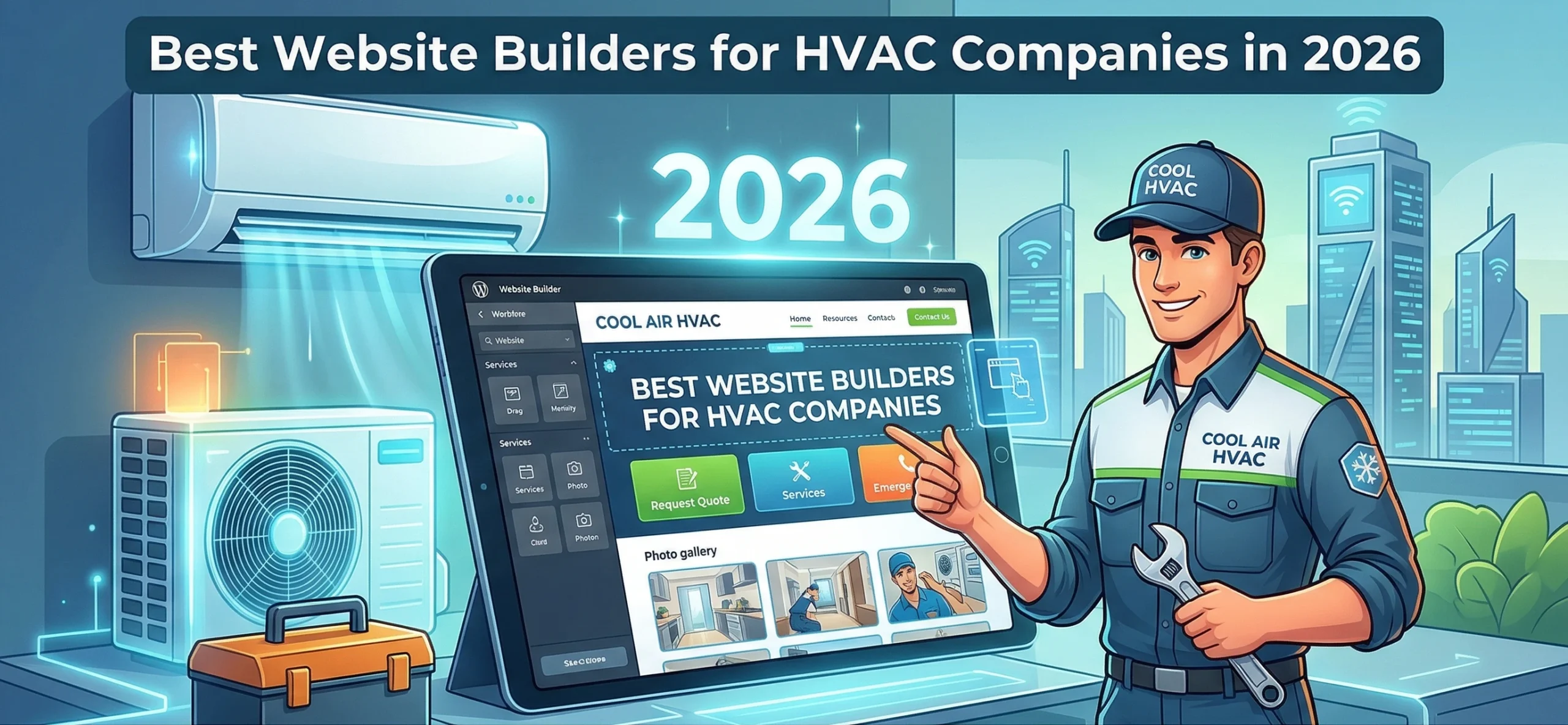
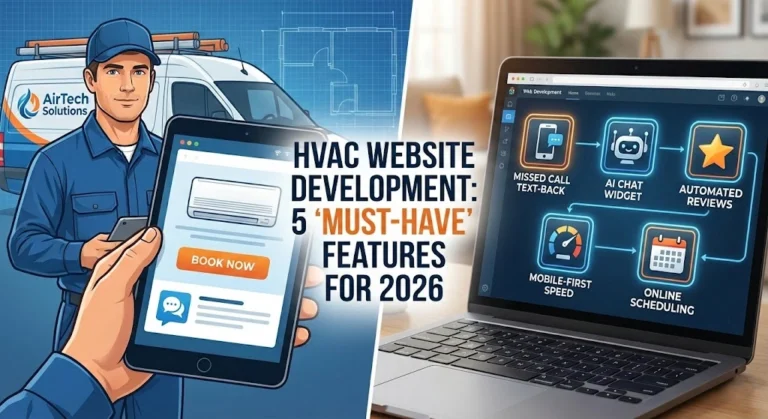
If you run an HVAC company and you’re trying to get more leads online, your website is the single most important tool you have. But not all website builders are created equal — especially for heating and cooling contractors who need to rank locally, load fast on mobile, and convert visitors into booked service calls.
In this guide, we break down the best website builders for HVAC businesses in 2026, what to look for before you pick one, and why most HVAC contractors end up getting better results with a professionally built WordPress site.
Quick Answer:
WordPress is the best platform for HVAC companies serious about SEO and lead generation. Wix and Squarespace are fine for a basic web presence but fall short on local search performance. GoDaddy and Yelp pages are not substitutes for a real website.
Table of Contents
What HVAC Companies Actually Need From a Website
Before comparing platforms, let’s talk about what matters for an HVAC website. Your website has one job: turn strangers into paying customers. That means it needs to:
- Rank on Google for local searches like “AC repair near me” or “furnace installation [your city]”
- Load fast on mobile — most homeowners search from their phones
- Make it easy to call or request a quote in seconds
- Build trust instantly with reviews, licensing info, and photos
- Target the right service areas so you show up in the towns you actually serve
With that in mind, here’s how the major platforms stack up.
The Best Website Builders for HVAC Companies (Ranked)
1. WordPress — Best Overall for HVAC SEO and Lead Generation
Best for: HVAC contractors who want to rank on Google and generate consistent leads
WordPress powers over 40% of all websites on the internet — and for good reason. For HVAC companies, it’s the gold standard. Here’s why:
- Full SEO control: Plugins like Yoast SEO or Rank Math let you optimize every page title, meta description, heading, and image alt tag for keywords like ‘HVAC company [city]’ or ’emergency AC repair [zip code]’
- Local SEO friendly: WordPress makes it easy to create location-specific service pages (e.g., ‘AC Installation in Smithtown, NY’) that rank in the towns you serve
- Fast loading speeds: With the right hosting and theme, WordPress sites score well on Google’s Core Web Vitals — a ranking factor
- Unlimited customization: Add review widgets, before/after galleries, financing calculators, and booking forms without restrictions
- Scalable: Start with 5 pages and grow to 50 as your business expands
The catch: WordPress has a learning curve. If you try to build it yourself, you’ll likely end up with a slow, poorly optimized site. That’s why most contractors hire a professional — but more on that below.
2. Wix — Easiest to Use, But Limited for Local SEO
Best for: Contractors who want to build something quickly with no technical skills
Wix has come a long way. The drag-and-drop builder is genuinely easy to use, and the templates look clean and modern. For a small HVAC company just getting started online, Wix can work.
However, Wix has real limitations when it comes to ranking in local search results:
- Slower page speed compared to optimized WordPress sites
- Less flexibility for technical SEO (structured data, schema markup for local businesses)
- Harder to scale with service area pages or blog content
- Your site lives on Wix’s infrastructure — you don’t fully own it
Bottom line: Wix is better than no website, but if you’re trying to compete for keywords like ‘HVAC repair [your city]’ against established local competitors, you’ll be fighting with one hand tied behind your back.
3. Squarespace — Beautiful Design, Weak on Local Search
Best for: Businesses where design and portfolio presentation matter most
Squarespace makes stunning websites. If you’re a photographer or boutique brand, it’s a great choice. For HVAC companies? Less so.
Squarespace’s SEO tools are basic. You can set page titles and descriptions, but you don’t have the granular control over technical SEO that WordPress offers. Creating multiple location-specific pages — a must for HVAC companies serving several cities — is clunky and limited.
4. GoDaddy Website Builder — Skip It
Best for: Honestly? Not much
GoDaddy is a great domain registrar and hosting provider. Their website builder, however, is underpowered and produces sites that typically rank poorly. If you’re using GoDaddy’s website builder in 2026, you’re leaving leads on the table. You’re better off having GoDaddy host a WordPress site instead.
5. Field Service Software Sites (Jobber, ServiceTitan, Housecall Pro)
These platforms are designed for running your business — scheduling, invoicing, dispatch — not for ranking on Google. Their built-in website features are basic at best. Use them for operations, but pair them with a real website for your online presence.
Key SEO Features Every HVAC Website Needs in 2026
Regardless of which platform you choose, make sure your HVAC website has these SEO elements:
- Google Business Profile integration: Your website and GBP listing should work together. Your NAP (name, address, phone) must be identical across both
- Location pages: Create individual pages for every city or town you serve (e.g., ‘AC Repair in Huntington, NY’)
- Service pages: Separate pages for each service — heating, cooling, heat pumps, emergency HVAC repair, maintenance plans, etc.
- Schema markup: LocalBusiness and HVAC contractor structured data helps Google understand your business
- Fast mobile experience: Google uses mobile-first indexing — if your site is slow on a phone, your rankings suffer
- Click-to-call button: Especially important on mobile — make it dead simple for someone to call you from your website
- Customer reviews: Embed or display Google reviews prominently to build trust
- SSL certificate: HTTPS is a ranking factor and a trust signal
Should You Build Your HVAC Website Yourself or Hire Someone?
This is the question most contractors ask. Here’s the honest answer:
You can build your own website on Wix or Squarespace in a weekend. But a DIY website almost never ranks well on Google because ranking requires proper keyword research, optimized page structure, fast loading speeds, and ongoing content — all of which take experience and time you probably don’t have while running a business.
A professionally built WordPress website, designed specifically for HVAC lead generation, will almost always outperform a DIY site in search results. That means more calls, more jobs booked, and a better return on your investment.
How Tobay Digital Builds HVAC Websites That Rank and Convert
At Tobay Digital, we build WordPress websites exclusively for contractors and trade businesses — HVAC companies, plumbers, electricians, roofers, and more. Every site we build includes:
- On-page SEO built in from day one — no add-ons required
- Location pages targeting every city you serve
- Mobile-first design that loads fast and converts visitors into calls
- Google Business Profile guidance to boost your local map rankings
- No upfront cost — we build your site for free with a simple flat monthly fee and no long-term contract
If you’re an HVAC contractor and you’re ready to start getting more leads from Google, we’d love to talk.
→ Get a free website mockup from Tobay Digital.
Frequently Asked Questions
What is the best website for an HVAC company?
WordPress is the best platform for HVAC companies that want to rank on Google and generate local leads. It offers the most flexibility for SEO, location targeting, and custom design.
How much does an HVAC website cost?
A basic DIY website on Wix or Squarespace costs $16–$49/month. A professionally built WordPress site typically costs $1,500–$5,000+ upfront, or with agencies like Tobay Digital, you can get a professional site built at no upfront cost for a flat monthly fee.
How do I get my HVAC company to show up on Google?
To rank on Google as an HVAC company, you need a well-optimized website with location-specific service pages, a fully built-out Google Business Profile, consistent NAP information across directories, and customer reviews. A professional web designer who specializes in local SEO can significantly speed up this process.
Is Wix good for HVAC websites?
Wix is easy to use and better than having no website, but it has limitations for local SEO. Most HVAC companies that are serious about ranking on Google and generating leads will outgrow Wix quickly and get better results with a professionally built WordPress site.