Table of Contents
10 Critical Plumber Website Mistakes That Cost You Jobs on Long Island
If you’re a plumbing contractor on Long Island and your phone isn’t ringing from your website, the problem probably isn’t your reputation — it’s your site. Most plumber websites in Suffolk County and Nassau County make the same avoidable mistakes that send homeowners straight to your competitors. In this guide, we break down the 10 most damaging plumber website design errors we see every day, why they kill your leads, and exactly how to fix each one so your site starts working as hard as you do.
Why Plumber Website Design Is More Than Just a Digital Business Card
When a pipe bursts in a Huntington home at 10 PM or a water heater fails in a Babylon townhouse on a Saturday morning, homeowners don’t flip through a phone book. They search “emergency plumber near me” on their phone, tap the first result that looks trustworthy, and call. If your plumber website design is slow, confusing, or looks like it was built in 2010, that homeowner clicks the back button in under three seconds and picks your competitor instead. That’s not a lost website visit — that’s a lost $3,000 water heater replacement, a lost $800 drain cleaning, and a lost customer who needs a plumber two or three times a year for the next decade.
The plumber website design choices you make today directly impact how many of those emergency calls land in your pipeline instead of someone else’s. Let’s get into the 10 mistakes that are quietly costing Long Island plumbing contractors thousands of dollars every month.
Mistake #1: No Click-to-Call Button on Mobile
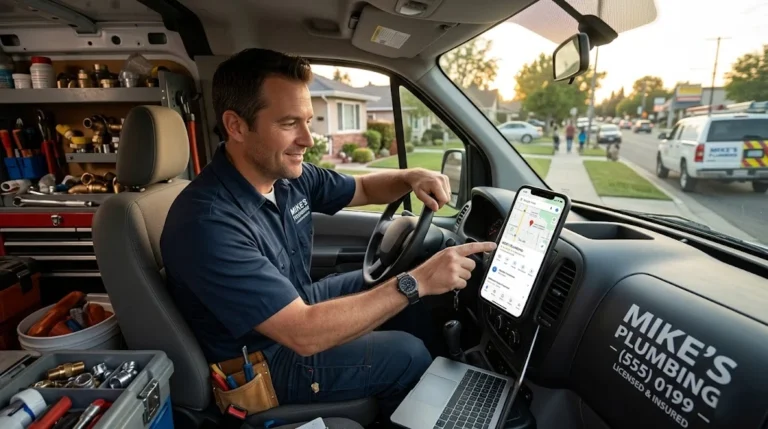
Over 70% of plumbing searches happen on mobile devices. A homeowner with a flooded basement isn’t going to tap your “Contact” link, scroll to a form, and type out their address. They want to tap a phone number and start talking immediately. If your plumber website doesn’t have a sticky, thumb-friendly click-to-call button that follows the user as they scroll, you’re forcing them to work too hard — and they won’t. Every plumber’s site needs a phone number prominently displayed in the header with an href="tel:" link, plus a floating call button on mobile screens. On a plumber website designed for Lead generation, the phone number is the single most important element on the page. Treat it that way.
Mistake #2: No Emergency Service Callout Above the Fold
Emergency plumbing calls — burst pipes, sewage backups, gas leaks — represent the highest-margin, most urgent leads in the plumbing industry. Yet most plumbing contractor websites bury their 24/7 availability somewhere halfway down the homepage or hide it entirely. Above the fold means the portion of your homepage visible without scrolling. That prime real estate on your plumber website design should immediately communicate: “We handle emergencies. We’re available now. Here’s the number.” Homeowners searching for emergency plumbing services in Patchogue, Riverhead, or Hempstead are in a panic. If they don’t see within one second that you can help, they’re gone. Add a bold banner or hero section that says something like “24/7 Emergency Plumbing — Call Now: (631) 555-0199” with a direct tap-to-call link. This single change can triple your emergency call volume from the website alone.
Mistake #3: Slow Load Times Killing Your Google Rankings
Google’s Core Web Vitals measure how fast and usable your site is, and plumbing websites are notorious offenders. Heavy hero images of wrenches and pipes, bloated WordPress themes with dozens of unused plugins, and uncompressed photos of completed jobs all pile on seconds of load time. If your plumber website takes more than 3 seconds to load, Google pushes you down in the search results, and mobile users bounce before they see your content. The fix is straightforward: compress every image to under 100 KB, use a lightweight theme purpose-built for contractors, enable browser caching, and serve images in WebP format. A fast plumber website loads in under 1.5 seconds — and ranks higher because of it. This directly affects your visibility when someone searches “plumber website design” or “best plumber in Suffolk County.”
Mistake #4: Generic Stock Photos Instead of Real Work
Nothing destroys trust faster than a plumber’s website covered in stock photos of smiling models in hard hats who have clearly never touched a pipe. Long Island homeowners want to see YOUR trucks, YOUR crew, YOUR work. Photos of a branded service van parked outside a recognizable Babylon or Patchogue home, a technician installing a water heater in a real basement, or a before-and-after of a cleared sewer line — those build instant credibility. Replace every stock photo on your plumbing website with authentic images from actual jobs. The plumber website design that converts isn’t the prettiest — it’s the most real. Homeowners in Huntington, Amityville, and Massapeka can tell the difference in half a second, and authenticity wins every time.
Mistake #5: No Dedicated Service Pages
A single “Services” page listing drain cleaning, water heater repair, sewer line replacement, and bathroom remodeling in bullet points won’t rank for any of those terms on Google. Each plumbing service needs its own dedicated page with 500 to 1,000 words of content that targets a specific keyword. A page at /drain-cleaning-long-island/ optimized for “drain cleaning services Suffolk County” will pull in organic traffic that a generic services page never could. The same goes for water heater installation, sewer line repair, slab leak detection, backflow prevention, and gas line services. Each page is a landing page that Google can index, rank, and send you leads from. This is the plumbing website design structure that separates contractors who get 50 calls a month from those who get five.
Mistake #6: No Local Area Pages for Towns You Serve
Long Island has dozens of distinct communities — Smithtown, Sayville, Port Jefferson, Garden City, Rockville Centre, Valley Stream, Freeport — and people in each one search for “plumber in [town name].” If your website only mentions “Long Island plumbing services,” you’re invisible to the homeowner in East Islip who specifically wants a plumber they recognize as local. Create dedicated location pages for every town in your service area. Each page should include your services offered in that area, local landmarks or neighborhoods, and testimonials from customers in that town. A plumber website design with 15 to 25 town pages targeting “plumber in Massapequa,” “plumbing services Huntington NY,” and “emergency plumber Babylon” will dominate local search results far more effectively than a single generic homepage. This is especially critical in Nassau County and Suffolk County where community identity runs deep and homeowners prefer hiring local tradespeople.
Mistake #7: Missing Trust Signals and Social Proof
When a homeowner lands on your plumbing website, they need to know three things within seconds: Are you licensed? Are you insured? Do other people trust you? Your plumber website design should display all three immediately. Include your NYS plumbing license number prominently — not buried on a footer link, but visible near your hero section. Show logos of professional associations (PHCC, BBB, local chamber of commerce). Display Google review stars with a live widget pulling real reviews from your Google Business Profile. Add video testimonials from satisfied customers in towns across Long Island. Include badges for “Licensed & Insured,” “24/7 Emergency Service,” and “Free Estimates.” These trust signals are not decoration — they’re conversion drivers. A plumber website that lacks social proof is like a contractor who shows up to a job without a uniform: the homeowner wonders if they’re legitimate before you even open your toolbox.
Mistake #8: Weak or Missing Google Business Profile Integration
Your Google Business Profile (GBP) and your plumber website work as a team. When they’re disconnected, you’re leaving money on the table. Embed your GBP reviews directly on your homepage and service pages. Add a section that says “See Our 4.9-Star Google Reviews” with a link to your full profile. Ensure the NAP (Name, Address, Phone) data on your website matches your GBP exactly — even a discrepancy like “St.” vs “Street” can confuse Google’s algorithm. Include a Google Map embed showing your service area on your contact page. The plumber website design that integrates Google signals tells the search engine “this business is real, active, and trusted” — and Google rewards that with higher placement in the local pack for searches like “best plumber near me” or “plumbing contractor Long Island.”
Mistake #9: No FAQ Section to Answer Common Questions
Homeowners researching plumbing services have questions before they call: “How much does a water heater replacement cost?” “Do you offer free estimates?” “How quickly can you respond to an emergency?” “Are your plumbers background-checked?” If your plumbing website doesn’t answer these questions, the homeowner has to call to find out — and most won’t bother. An FAQ section on your plumber website design serves three purposes: it pre-qualifies leads (people who read your FAQ and still call are serious), it ranks in Google’s “People Also Ask” boxes for long-tail queries specific to plumbing, and it reduces the time your office staff spends answering the same basic questions on every call. Structure your FAQ with clear, specific answers. Don’t write “Call us for pricing” — give a range like “Water heater replacement costs between $1,200 and $3,500 depending on type and installation complexity.” Transparency builds trust, and trust generates calls.
Mistake #10: Building on the Wrong Platform (Wix, Squarespace vs WordPress)
Many plumbing contractors start with a DIY website builder like Wix or Squarespace because it seems easy and cheap. For a hobby blog, that works fine. For a plumbing business that needs local SEO, multiple service pages, town-specific landing pages, review schema, and the ability to scale as the business grows, these platforms are a trap. They limit your SEO capabilities, make URL structures rigid, restrict structured data implementation, and often produce bloated code that slows page load times — a critical mistake when competing for “plumber website design” searches in a crowded market like Long Island.
WordPress powers over 40% of all websites and is the platform of choice for plumbing contractors who need their site to generate leads, not just exist online. With WordPress, you get full control over URL structure (essential for those dedicated service and location pages), SEO plugins like Yoast or RankMath that handle schema markup for FAQ pages and local business data, easy blog publishing to capture informational searches, and a massive ecosystem of plugins for forms, review widgets, and live chat. The plumber website design that consistently outranks competitors on Google? Almost always WordPress. A plumber website built on a DIY platform may cost less upfront but costs far more in lost leads over time. When you calculate “plumber website cost” over three years, WordPress pays for itself within the first month of increased conversions.
What a High-Converting Plumber Website Looks Like
After working with plumbing contractors across Nassau County and Suffolk County, we’ve identified the exact structure that consistently converts website visitors into phone calls:
- Header: Logo left, phone number right with tap-to-call link on mobile, “24/7 Emergency” badge
- Hero section: Headline targeting the primary keyword (“Long Island’s Most Trusted Plumbing Contractor”), subheadline with a specific value proposition, dual CTAs (call button + estimate form)
- Services grid: 6 to 8 service cards linking to dedicated service pages (drain cleaning, water heater, sewer line, etc.)
- Trust bar: License number, insurance badge, Google review stars, years in business, service area coverage
- Testimonials: 3 to 5 real customer reviews with names, towns, and ideally video
- Service area map: Interactive or visual map of Long Island towns served, with links to individual town pages
- FAQ section: 5 to 8 plumbing-specific questions with detailed, helpful answers
- Footer: Full NAP data, service links, social media, privacy policy, sitemap link
This plumber website design structure is proven across dozens of trade contractors in the New York metro area. Every element serves a purpose — either building trust, capturing leads, or boosting SEO rankings. Nothing is decorative.
Related Articles
- Best Website Design for Plumbers — What Plumbers Who Rank on Google Actually Do
- Plumber Website: Wix vs WordPress vs Custom Design in 2026
- Roofing Website Design: Why Templates Fail and Custom Sites Get Calls
Frequently Asked Questions
How much does a professional plumber website cost on Long Island?
A professionally designed plumbing website typically ranges from $1,500 for a basic single-site build to $5,000+ for a comprehensive site with dedicated service pages, SEO optimization, and custom features. DIY platforms like Wix or Squarespace cost $20 to $50 per month, but the lost leads from poor SEO and limited functionality usually far exceed the investment difference within the first quarter.
How long does it take for a new plumbing website to rank on Google?
With proper SEO setup — including service pages, location pages, keyword optimization, and Google Business Profile integration — a new plumber website can start ranking for long-tail local keywords within 4 to 8 weeks. Competitive terms like “plumber near me” in saturated Long Island markets typically take 3 to 6 months to break into the top three positions. Consistent blog publishing and review acquisition accelerate this timeline significantly.
Do I really need a separate page for each plumbing service?
Yes. Google ranks individual pages, not entire websites. A single “Services” page cannot rank for “drain cleaning Long Island,” “water heater repair Suffolk County,” and “sewer line replacement Nassau County” simultaneously. Each dedicated service page targets a specific keyword, builds topical authority, and gives Google a clear page to rank for that search. Six service pages means six chances to appear in search results. One combined page means one chance at best.
Should my plumbing website include pricing information?
Including price ranges — not exact quotes — is becoming a strong differentiator in the plumbing industry. Homeowners appreciate transparency and are more likely to call a plumber who gives them a ballpark figure upfront. For example: “Drain cleaning starts at $150” or “Water heater installation: $1,200 to $3,500.” This pre-qualifies leads, reduces tire-kicker calls, and positions your business as honest and straightforward — qualities homeowners actively look for when choosing a plumbing contractor.
Can I update my plumbing website myself after it’s built?
Yes. WordPress websites are designed for non-technical users. You can add new blog posts, update service descriptions, change pricing, add testimonials, and publish seasonal promotions without any coding knowledge. A good web designer will provide a brief training session so your office manager or marketing person can keep the site fresh — which is important because Google rewards websites that are regularly updated with new content.
What makes a plumber website different from a general contractor website?
Plumbing websites have unique requirements that general contractor sites don’t. Emergency service prominence is critical — plumbing customers often need immediate help and their website experience must reflect urgency. Service page structure differs too, with plumbing sites needing pages for individual services like drain cleaning, water heaters, and sewer lines, while general contractor sites focus on project types like kitchens and additions. The trust signals also differ: plumbing sites prioritize licensing numbers and same-day service guarantees, while contractor sites lean heavily on portfolio galleries and project case studies.
If your plumbing website is making any of these 10 mistakes, every day it’s live is another day of leads going to your competitors. The fix doesn’t require a complete rebuild from scratch — it requires a plumber website design built from the ground up with lead generation as the top priority, not an afterthought.